When an outfit works and you cannot say why, texture is usually doing the heavy lifting. When an outfit is off and you cannot say why, a texture clash is almost certainly the culprit. It is the dimension of dressing that most people operate without thinking about, which is why understanding it creates such immediate, visible results.
What texture actually is
In fashion and textile terms, texture refers to the surface quality of a fabric: its weight, sheen, drape, structure, and hand feel. These are distinct properties that interact with light, movement, and each other.
Weight is how much mass the fabric has: heavy denim versus light linen, dense wool versus fine knit. Heavier fabrics tend to structure the body; lighter fabrics tend to move with it.
Sheen is how reflective the fabric surface is. Think of the difference between matte cotton and silk charmeuse, or between brushed flannel and polished satin. High-sheen fabrics catch light and draw the eye; matte fabrics recede.
Drape is how the fabric falls. Does it hold a shape independently (stiff) or follow the body's contours (fluid)? Textile engineers measure drape coefficient precisely because it determines how a garment will behave on the body: something that is invisible on a hanger and immediately visible when worn.
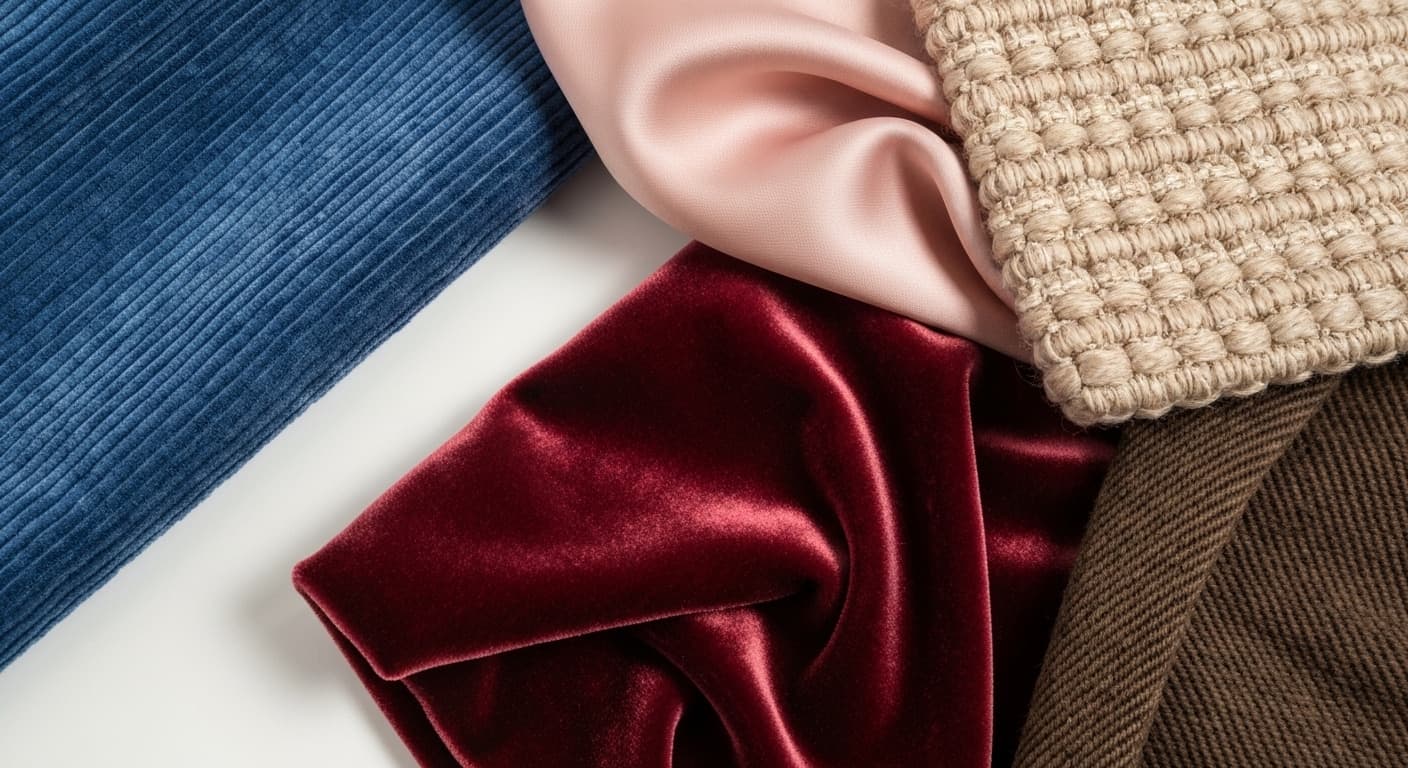
Nap and surface interest refers to whether the fabric has a tactile quality visible at close range: the pile of velvet, the loop structure of boucle, the grain of corduroy, the weave of a textured tweed. High surface interest catches the eye up close; smooth surfaces read as clean from a distance.
Why texture contrast works
A monochromatic outfit can look either flat or sophisticated. The difference is almost always texture contrast. When every piece is the same colour and the same texture, the outfit has no visual variation to interest the eye. When the same colour palette is expressed in different surfaces — a matte trouser with a silk blouse, a smooth knit with a textured coat — the outfit has depth without being busy.
This is the mechanism behind outfits that “just work” even when they are simple. A cream silk shirt tucked into camel wool trousers works because the sheen contrast between silk and wool creates visual interest. The same shirt with camel silk trousers is flatter: same colours, less contrast, less depth.
Fashion scholars studying visual complexity in dress have found that a moderate level of visual contrast consistently reads as more intentional than either very low or very high contrast. Texture is the least obvious way to add that contrast. It reads as sophisticated rather than busy.
The 2026 moment for tactile dressing
The dominance of digital interaction, screens, video calls, social media documentation, has created a counter-desire for physical, tactile experience. Velvet, boucle, washed silk, mohair, heavy linen: fabrics noticed by touch, not just sight. They read differently in person than in a photograph, which makes them a quiet statement in an image-saturated culture.
The 2026 collections have leaned into this hard. Tactile fabrics are prominent across multiple major houses and across the high-street translation of runway trends. This is not a trend that requires buying into a whole new aesthetic. One textured piece added to an otherwise smooth wardrobe activates it.
The two practical rules
Contrast surfaces, not weights. The most reliable texture combination pairs one high-surface-interest piece with smooth ones. A boucle jacket with smooth trousers and a plain shirt. A velvet skirt with a matte top. A textured knit with clean denim. The textured piece is the statement; the smooth pieces are the frame. Two high-surface-interest pieces together tend to compete rather than complement.
Match the weight register of the occasion. Heavy fabrics communicate gravitas and formality; light fabrics communicate ease and informality. Lightweight linen at an evening event reads underdressed regardless of the colour or cut. Heavy wool on a casual weekend reads overdressed in the same way. When the weight register does not match the occasion, no other styling choice fixes it.
Reading your own texture pattern
Look at the pieces in your closet you reach for most. They likely share a texture register: mostly matte, mostly structured, mostly lightweight, mostly textured. This is your texture preference, and it is probably consistent with your style archetype. Refined and Functional wardrobes tend toward smooth, clean surfaces. Expressive wardrobes tend toward surface variation and tactile interest. Transitional wardrobes often have a mix that has not yet settled into a coherent register.
The pieces that feel most like you are in the same texture register. The pieces that never quite work are probably in a different one. That tension is usually where the “I have nothing to wear” feeling is hiding: not in the colours, not in the silhouettes, but in the surfaces.